
**torque#
Description#
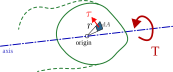
This boundary condition imposes shear forces on a specified boundary set to impose a torque. The moment vector is given by
where \(\vect t = \ten{\sigma}\cdot\vect n\) is the traction vector, and \(\vect n\) is the surface normal.
The torque about the axis defined by the unit vector \(\vect e\) is
If we assume that the surface normal is aligned with the axis: \(\vect n = \vect e\) and decompose the traction into normal and tangential components:
The circumferential direction \(\vect e_\theta\) is defined as
Finally,
Syntax#
**torque
\(~\,~\,\) bset_name (origin) (axis) value table
- bset_name
is the name of the bset on which this shear forces \(\vect \tau\) are applied.
- origin
is the rotation origin vector.
- axis
is the rotation axis vector \(\vect e\).
- value
is the value of shear forces to be applied (to be multiplied by the table).
Example#
An example can be found in $Z7PATH/TESTS/Static_test/INP/torque.inp.
***bc
 **impose_nodal_dof
   bottom  U1 0.0
   bottom  U2 0.0
   bottom  U3 0.0
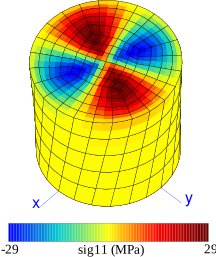
 **torque top_face (0.,0.,2.) (0.,0.,1.) 100. time
The previous load is applied to a cylinder with radius \(R=1\) mm. To verify the applied torque, the following post-processing can be used:
****post_processing
 ***global_post_processing
  **nset top
  **file node
  **process static_torsor
   *point (0. 0. 2.)
   *file torque.dat
****return
The output of this post-processing is torque.dat which will contain the values of resultants and
moments. The torque value can be found in the last column of the file, which shows a value of
\(209.435\). The analytical value is given by