
**process onera#
Description#
This command can be used in replacement of **process LCF to perform
damage cumulation within a rainflow counting procedure. Cumulation rules
and material parameters are the same as in the case of
**process LCF. Given a complex multiaxial load sequence the
post-processor performs the following operations:
for each point (integ point, node) decompose the input into elementary sub-cycles using the multiaxial rainflow algorithm (
**process multirange, see multirange)for each elementary cycle, compute the number of cycles to failure according to the onera fatigue model (
*process fatigue_rainflow, see fatigue_rainflow)optionally, if creep is included, compute the creep damage associated to each elementary cycle, using the
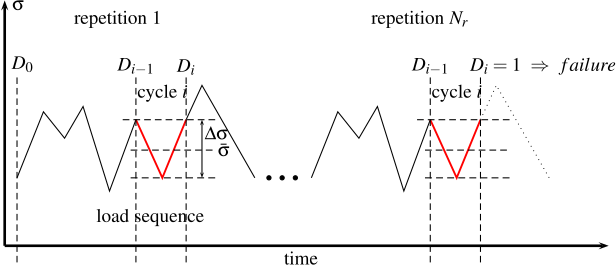
*process creepmodel (see creep ),performs damage cumulation, starting from an initial \(D_0\) (that may be non-zero if a preloading is defined). As shown in the next figure, the input loading sequence is repeated until a damage value of \(D=1\) is obtained. The number of cycles to failure computed by the post processor, then corresponds to the maximum number of repetitions \(N_r\) applied for the current point. During each repetition of the loading sequence, the damage \(D_i\) associated to each elementary sub-cycle, is cumulated to the total damage \(D\) using the selected cumulation rule (options
LC,NLCorNLC_ONERA).
Syntax#
**process onera
[ *reverse reverse ]
\(~\,\) *mode LC | NLC | NLC_ONERA
\(~\,\) *fatigue fatigue_rainflow section1
[ *creep name2 section2 ]
[ *scale lin | log ]
[ *preload b1-e1 [/r1] c2- e2 [/r2 ] … bn -en [/rn ] ]
[ *cycle b1-e1 [/r1 ] b2-e2 [/r2 ] … bn-en [/rn ] ]
The main difference with **process LCF is the *reverse keyword,
that allows to specify the maximum number of sub-cycles stored in the
calculation, within the ones detected by the rainflow counting algorithm
(see the **process multirange command). Default value is
reverse=3. Note that **process multirange gives out cycles with
maximum amplitude first, such that output is always given for the
reverse most damaging elementary cycles. However, regardless of the
reverse number, damage cumulation is always done for all elementary
cycles detected by the rainflow algorithm.
Contrary to **process LCF, the only fatigue model allowed is the one
implemented in the **process fatigue_rainflow post-processor (see
this command).
Note also, that the creep damage part is optional in this post-processor, and that cumulation can be restrained only to the fatigue damage due to sub-cycles detected by rainflow counting.
The optional command *cycle can be used to define a complex cycle
from the output maps available in the results file (that may or not be
selected by means of the **output_number command ).
Cycle definitions have the form bi-ei/ri, where bi and ei are map
numbers defining respectively the beginning and the end of sequence
number i. r1 is the number of times this sequence should be repeated
(default is ri=1, when this optional argument is not defined). An
arbitrary number of sequences can be given, thus allowing to re-arrange
output maps stored in results files in a loading sequence of arbitrary
complexity. In this case, the number of cycles to failure, will
correspond to the number of times this complex loading path can be
repeated until failure.
Command *preload, with a syntax equivalent to *cycles, can also
be used to define a preloading phase generating an initial damage before
cycling occurs. In this case the number of cycles to failure calculated
will correspond to the number of times the cyclic loading path can be
repeated, taking into account a non-zero initial damage corresponding to
the *preload definition.
Note that when *preload is defined, it is mandatory to add also a
*cycle command to specify which subset of total input maps do
correspond to the cycle definition. Also, map numbers given as argument
to the *preload and *cycle commands are in fact relative, and
depend on the **output_number definition specified before the
current **process onera block, i.e., those are ranks in the current
selection.
Output is as follows:
ncycthe number of elementary cycles detected by the rainflow algorithm.the number of cycles of failure
NF\(i\) corresponding to fatigue damage associated with the reverse most damaging sub-cycles obtained by decomposition of the input sequence.if the option
*creepis included the number of cycles to failureNCassociated with creep damage for the whole loading sequence.the number of cycles to failure
NR_mode obtained by cumulation of the previous damage mechanisms,the initial damage
Dpreloadcorresponding to preloading sequences when the command*preloadis used.