
memory#
Description#
This behavior is a ZebFront implementation of a strain range memory
isotropic hardening model described by Lemaitre and Chaboche
[M10]. The model has 2 non-linear kinematic
hardening components (coefficients C1, D1, C2, and
D2), and a Norton type flow law (coefficients K and
n).
The yield criterion is given by
where \(J(\diamond) = \sqrt{\dfrac{3}{2}\diamond^{dev}:\diamond^{dev}}\), and \(\diamond^{dev}\) is the deviatoric part.
The viscoplastic flow rule is
The constitutive equations are:
where \(\tenf{\mathbb{C}}\) is the elasticity fourth-rank tensor. The evolution equations for kinematic hardening internal variables are
where \(\ten n=\dfrac{3}{2}\dfrac{\ten \sigma^{dev}-\ten X_1-\ten X_2}{J(\ten \sigma-\ten X_1-\ten X_2)}\) is the normal to the loading surface \(f=0\).
As observed for 316L stainless steel [M10], the asymptotic value of the cyclic hardening (\(Q\)) may depend on the strain amplitude. Two additional variables are added to keep track of the plastic strain range: the center \(\ten{\xi}\) and the radius \(q\) of the plastic strain enveloping surface \(F\),
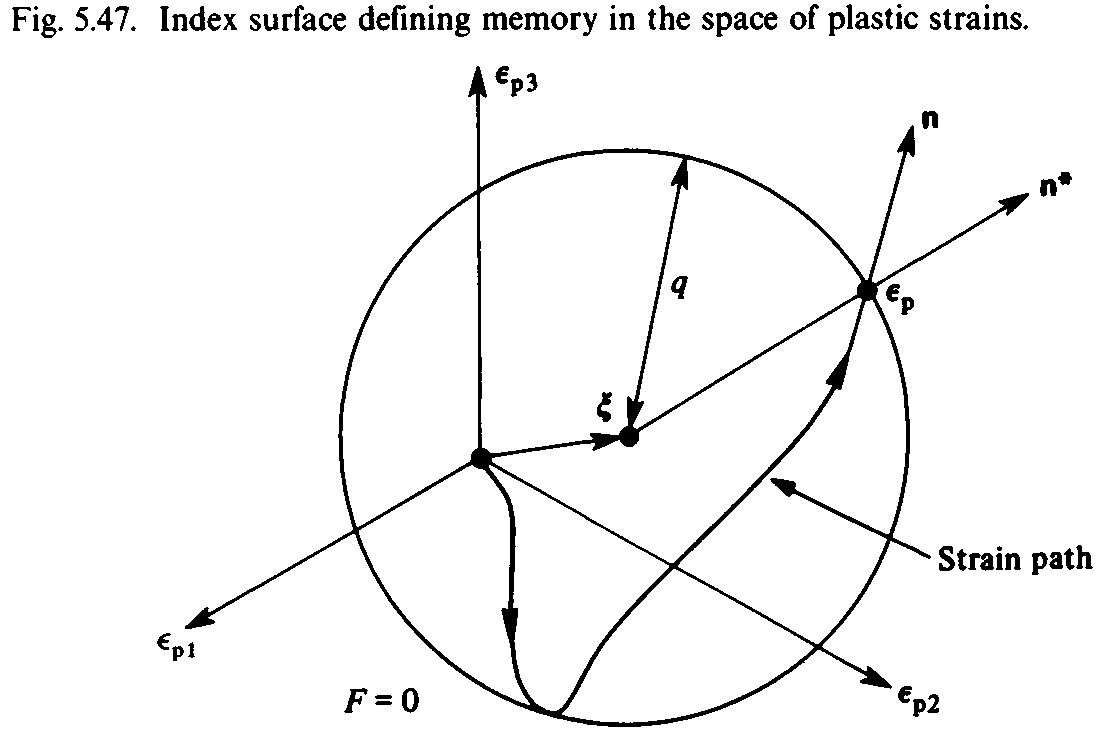
The enveloping surface of previous strains will move only when the current strain state is on the surface \(F=0\), and that the flow occurs in the direction external to the surface. The evolution equations are given by:
where \(H(x)=1\) if \(x\geq 0\), \(H(x)=0\) if \(x<0\). The variable \(\eta\) is determined by the consistency condition \(dF=0\):
where \(\ten n^*\) is the normal to the index surface \(F = 0\):
The asymptotic value \(Q_{sat}\) of isotropic hardening depends on the variable \(q\) as:
Syntax#
***behavior memory
\(~\,\) **elasticity <ELASTICITY>
\(~\,\) **model_coef
\(~\,~\,~\,\) coefs
Example#
***behavior memory
 **elasticity isotropic
   young 200000.
   poisson 0.3
 **model_coef
   n     5.
   K     50.
   C1    1000.0
   D1    20.
   C2    12000.
   D2    120.
   R0    50.
   b     25.
   Q0    25.
   Qsat  400.
   mu    50.
***return
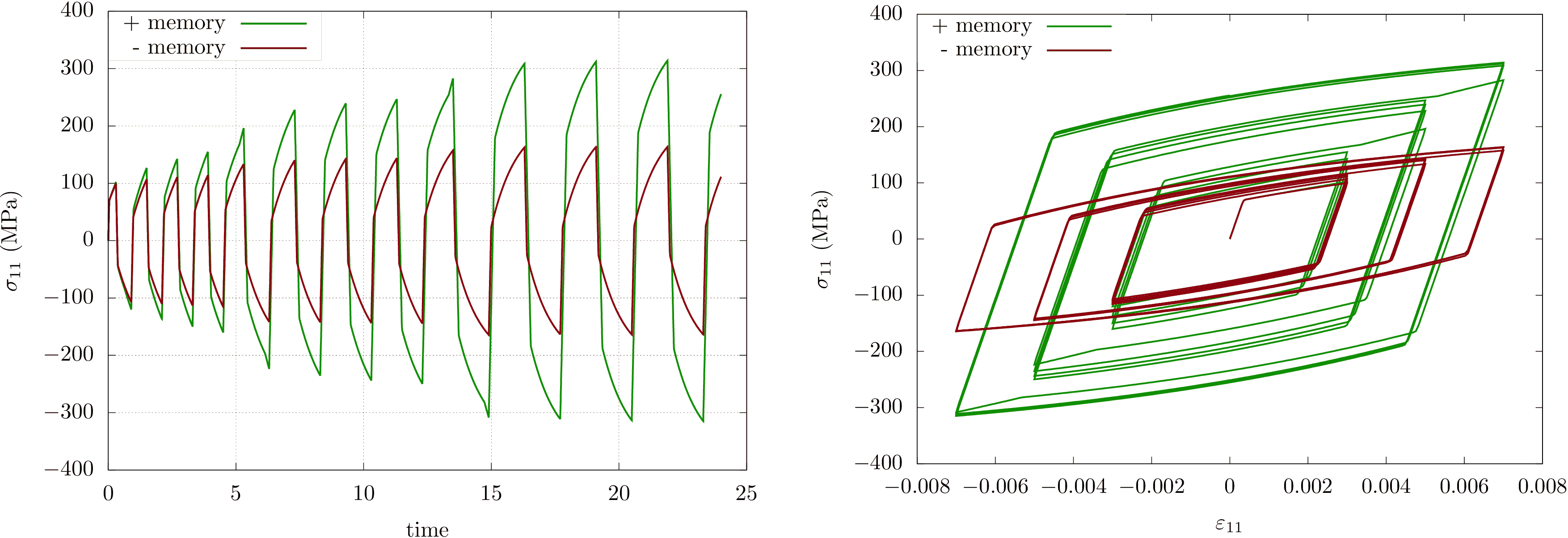
Fig. 16 A cyclic tension/compression loading with different strain amplitudes (4 cycles fo each amplitude) for models with and without memory.#
Note
To describe strain range memory effect, one can also use
nonlinear_with_memory isotropic hardening with gen_evp behavior as:
***behavior gen_evp
 **elasticity isotropic
   young 200000.
   poisson 0.3
 **potential gen_evp ev
  *flow norton
   n 5.
   K 50.
  *isotropic nonlinear_with_memory
   R0 50.0000
   b 25.0000
   Q0 25.0000
   Qsat 400.000
   mu 50.0000
  *kinematic nonlinear
   C 1000.00
   D 20.0000
  *kinematic nonlinear
   C 12000.00
   D 120.0000
 ***return