
viscoelastic_spectral#
Description#
This behavior defines a spectral viscoelastic model. The model defines the stress, \(\bf sig\), to the strain \(\bf eps\) by the following differential equations system:
\(C_0\) is the elastic matrix. Note that \(S_0\) used latter is defined by : \(S_0=C_0^{-1}\).
\(g(\sigma)\) is the viscous non linear function
\(\tau_i\) and \(\mu_i\) define the spectrum. Each mechanism \(X_i\) is associated with a relaxation time \(\tau_i\) weighted by \(\mu_i\). The whole strain family (\(X_i\)) describes a Gaussian continuous spectrum.
Note#
For the moment, the thermal strains are not taken into account.
Syntax#
The material file structure for the viscoelastic_spectral model
consists of an elasticity object, the definition of spectrum, of the
viscous_effects tensor and of the asymptote. The syntax for this
behavior model is the following:
***behavior viscoelastic_spectral [ modifier ]
\(~\,\) **elasticity <ELASTICITY>
\(~\,\) **spectrum …
\(~\,\) **viscous_effects …
\(~\,\) **reversible_asymptote …
Options **spectrum represent the spectrum which defined
\(\mu_i\) and \(\tau_i\) (see next figure).
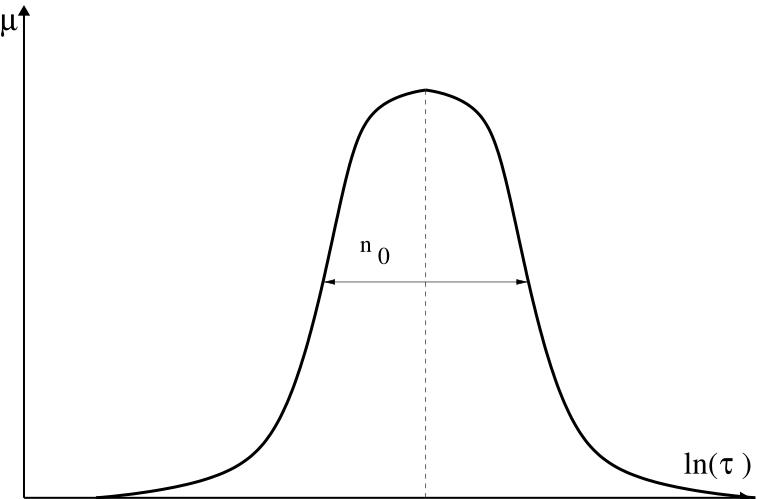
The spectrum is defined by the following form:
**spectrum
[ *limit double]
[ *n1 double]
[ *n2 double]
\(~\,\) *nt interger
\(~\,\) *nc COEFFICIENT
\(~\,\) *n0 COEFFICIENT
See the figure for the meaning of nt, nc and n0. n1 and n2 can be read
in the material file (*n1 and *n2) or calculated such as
\(\mu(n1)>limit\) and \(\mu(n2)<limit\).
Note
By default limit is equal to 1.e-4 and nt to 30.
The option *viscous_effects defined the viscous effects tensor
\(C_R\).
**viscous_effects
\(~\,\) *lrt COEFFICIENT
\(~\,\) *lrc COEFFICIENT
\(C_R\) is defined such as :
for i equal 1 to 3 :
for i equal 4 to 6 :
and if \(i{\neq}j\) for i and j equal 1 to 3 (isotropic condition):
with \(lrn=(lrt*S_0(1,1)-lrc*S_0(2,2))/S_0(1,2)\).
Finally the option *reversible_asymptote is used to define the non
linear function \(g(\sigma)\).
**reversible_asymptote
\(~\,\) *beta COEFFICIENT
\(~\,\) *p COEFFICIENT
Remark#
beta=0 is equivalent to a classical linear asymptote.
Note
Another definition of the asymptote (**plastic_asymptote) is also
implemented but not documented here because still under development.
Stored Variables
The internal variables stored for this model are the total strain (code
etoxx), the tensorial variables \(X_i\) (code
kip#xx).
prefix |
size |
description |
default |
|---|---|---|---|
|
T-2 |
total (small deformation) strain |
yes |
|
T-2 |
Cauchy stress |
yes |
|
T-2 |
elastic strain |
yes |
|
T-2 |
anelastic strain |
yes |
|
T-2 |
\(X_i\) variable |
no |
The code names will replace the # symbol with a sequential number
from 1. to nt.
The default saving of variables in the output files are only those marked by yes in the previous table.
Example#
***behavior viscoelastic_spectral
  **elasticity isotropic
    young 2800.
    poisson 0.3
  **spectrum
          *n1 -30.
          *n2  30.
          *nt  50
          *nc  7.
          *n0  3.
  **viscous_effects
          *lrt 0.6
          *lrc 0.6
  **reversible_asymptote
          *beta 1.
          *p    1.
***return