
**open_bset#
Description#
This command takes as input a bset (faset in 3D, liset in 2D), and duplicates nodes at the corresponding interface, to insert discontinuities (contact definitions, cracks …) in the initial mesh. In the output mesh, the following items are available:
2 bsets named
SIDE0andSIDE1, obtained by duplicating the input bset for each side of the created discontinuity. Note that bset elements are automatically ordered such that the normal is pointing outside (a property needed if those bset are to be used for contact definitions).2 elsets named
SIDE0andSIDE1with elements connected to the previous bsets.set of nodes located at the tip of the discontinuity, and ordered in continuous lisets named
FRONT0,FRONT1…FRONTn, where n is problem-dependent.nset
FRONTwith all tip nodes in the previous lisets.
Note that this command is only allowed for linear input meshes (commands **quad_to_lin, **lin_to_quad may be used to bypass this limitation).
Also note that if the input bset contains duplicated faces, the mesher may produce erroneous results. It is recommended to verify the input bset, and/or use **cleanup_bsets to remove duplicates.
Syntax#
**open_bset\(~\,\)
*bsetbname \(~\,\) [*surfacesname ] \(~\,\) [*elsetename ] \(~\,\) [*branches] \(~\,\) [*create_interface] \(~\,\) [*interfacebset ] \(~\,\) [*create_origins]
- bname
is the name of the bset, for which nodes need to be duplicated to create a discontinuity in the input mesh,
*surfacetakes as argument the name sname of an nset containing surface nodes. In this case surface nodes are removed from the front lisets (the front nodes ending points are preserved, however). You may want to use
**unshared_facesto generate such an nset. See examples below.*create_interfaceinterface elements are automatically added between both sides of the discontinuity. Corresponding interface elements are included in the output
INTERFACEelset.*interfacespecifies the bset where to create interface elements. By default, bname is considered.
*branchesA flag to handle “branched” bsets (see example 2 below). By default, the flag is set to
false.*create_originsoutput node sets specifying the start and the end node of each front.
Examples#
Example 1#
**open_bset
 *surface SURFACE
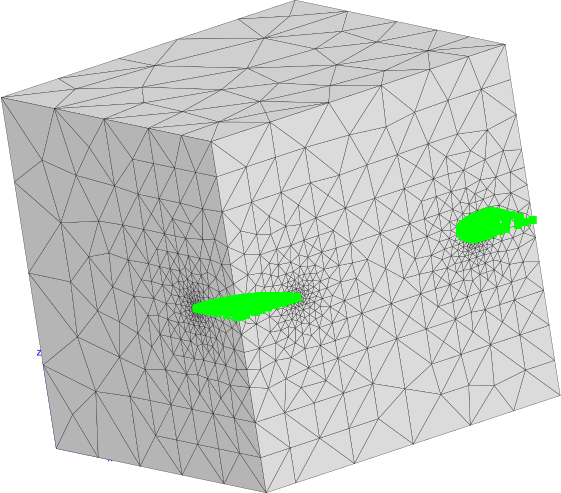
 *bset to_open
|
|
input mesh with bset to open |
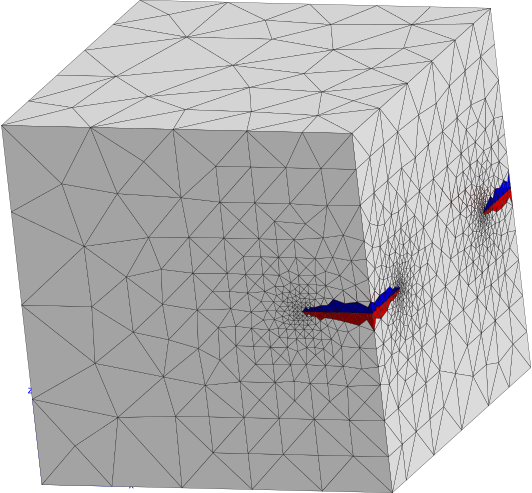
elsets |
|
|
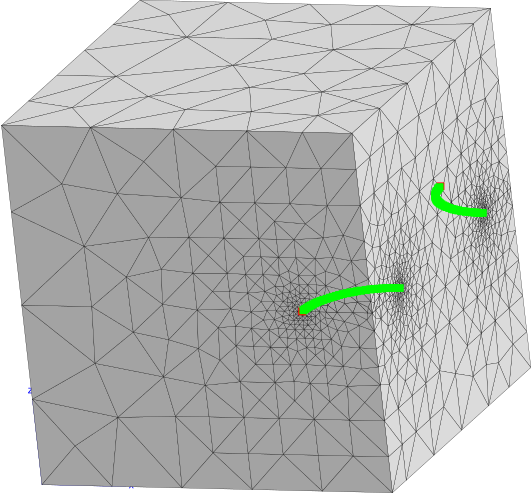
2 lisets created: |
FRONTS without the |
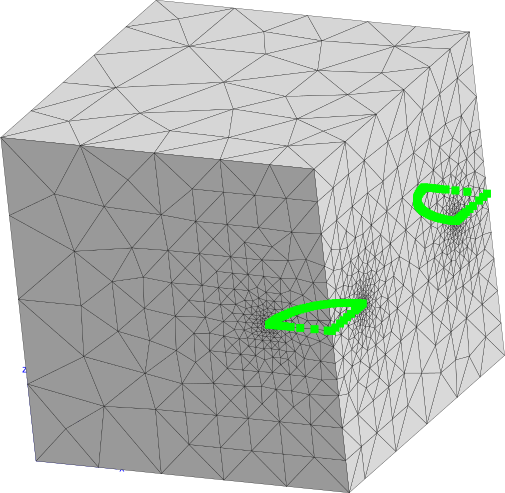
Example 2#
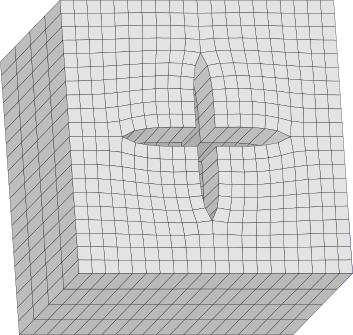
Fig. 7 **open_bset only duplicates nodes. A biaxial tension is applied on the cube to emphasize the discontinuity.#
***mesh
 **open open_branch
 **unshared_faces
 **open_bset
  *bset cross
  *surface boundary
  *branches