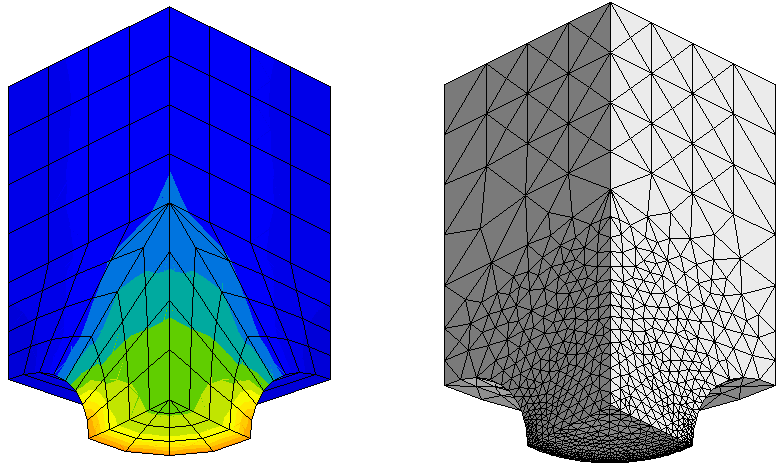
**yams_by_elset#
Description#
This command is derived from **yams_ghs3d mesher, and can be seen as a “mesher modifier”. It allow to preserve elsets topology during yams_ghs3d remeshing process. This is achieved by internally providing a “color” for each named elset. The colored areas borders topology are then “protected”.
Syntax#
The command has the following syntax:
**yams_by_elset
\(~\,\) [ *elset elset-name1 elset-name2 … ]
\(~\,\) [ current **yams_ghs3d options]
*elsetnames of elsets to be preserved.
Example#
See tests in folder $Z7PATH/TESTS/Distene_test/INP/.
****mesher
 ***mesh cyl4
  **open cyl.geof.ref
  **yams_by_elset
   *elset center attach
  %%% yams_ghs3d options
   *force_meshadapt
   *nb_iter_surf 1
   *nb_iter 3
   *absolu
   *min_size 0.1
   *max_size 0.1
   *refinement 0.1;
****return
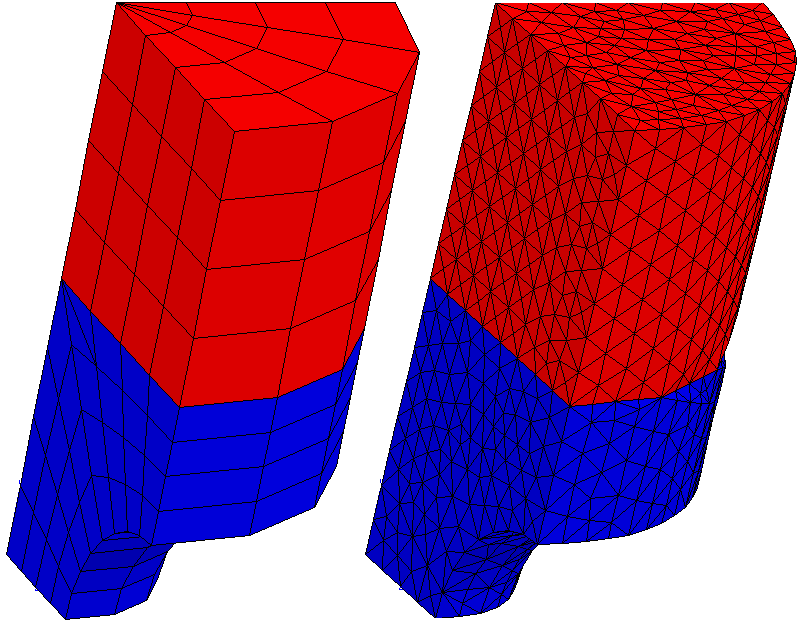
**refine_elset#
Description#
This command is derived from **yams_ghs3d mesher, and can be seen as a “mesher modifier”. It allows to remesh a single elset using yams_ghs3d remeshing process, without modifying neighboring element. This is achieved by extracting the target elset in
a separate mesh and imposing the conservation of the interface (interface : the skin shared between the elset and the remaining of the mesh).
Syntax#
The command has the following syntax:
**refine_elset
\(~\,\) [ *elset elset-name ]
\(~\,\) [ *material_elset material_elset_name ]
\(~\,\) [ current **yams_ghs3d options]
*elsetname of elset to be remeshed.
*material_elsetthis command can be used for multi-material models. It will add all elements created by remeshing elset “elset_name” to elset “material_elset_name”.
*maxsize(inherited from
**yams_ghs3d)
note that by default the element max size is automatically calculated as the maximum size of element at the interface of remeshed elset note that
Example#
See tests in folder $Z7PATH/TESTS/Distene_test/INP/.
****mesher
 ***mesh cyl3
  **open cyl.geof.ref
  **refine_elset
   *elset center
   *material_elset ALL_ELEMENT
  %%% yams_ghs3d options
   *nb_iter 3
   *absolu
   *min_size 0.03
   *preserve_faset haut-ext bas-ext U1=0 U3=0
   *refinement_origin bas-ext
   *refinement y*y;
****return
**remesh_from_results#
Description#
This mesher allows to build a metric map (for Distene tools) based on the results of a previous computation. The metric map definition can be found in **yams_ghs3d section or in the Distene manuals. It can be useful to refine a mesh according to the gradient of given field or an a-posteriori error estimator.
In this mesher, the metric map can be partially computed from results over a defined elset, the remaining of the map (corresponding to elset complement to the mesh) is simply filled with the actual mesh metric. We can also in this case choose a conservative remeshing based on refine_elset (outside elset will remain unchanged) or a less conservative remeshing based on yams_ghs3d (outside elset will change but keeping the same characteristic element length).
Syntax#
The command has the following syntax:
**remesh_from_results
\(~\,\) [ *result_name result-file-name ]
\(~\,\) [ *Z8 ]
\(~\,\) [ *var var-name ]
\(~\,\) [ *card card-number ]
\(~\,\) [ *power power-coefficient ]
\(~\,\) [ *free_interface ]
\(~\,\) [ current **refine_elset options]
*result_nameresults file name.
*Z8add it to specify that results are in Z8 format (.zres folder). If omitted Z7 format is assumed.
*varname of the variable in the results database to be used for metric computation.
*cardindex of the results card to be used for metric computation.
*powermodify the value of the variable
varsuch that \(var = var^{power}\).*free_interfaceif set, activate the “less conservative remeshing” otherwise the
refine_elsetstrategy is used.
Example#
See tests in folder $Z7PATH/TESTS/Distene_test/INP/.
****mesher
 ***mesh cylr4
  **remesh_from_results
   *result_name CYL/cyl
   *var sig22
   *card 2
   *power 0.5
   *free_interface
  %%% refine_elset/yams_ghs3d options
   *elset center
   *absolu
   *min_size 0.01
   *max_size 0.15
   *nb_iter 3
   *preserve_faset haut-ext bas-ext U1=0 U3=0
****return